Ready at a Moment’s Notice
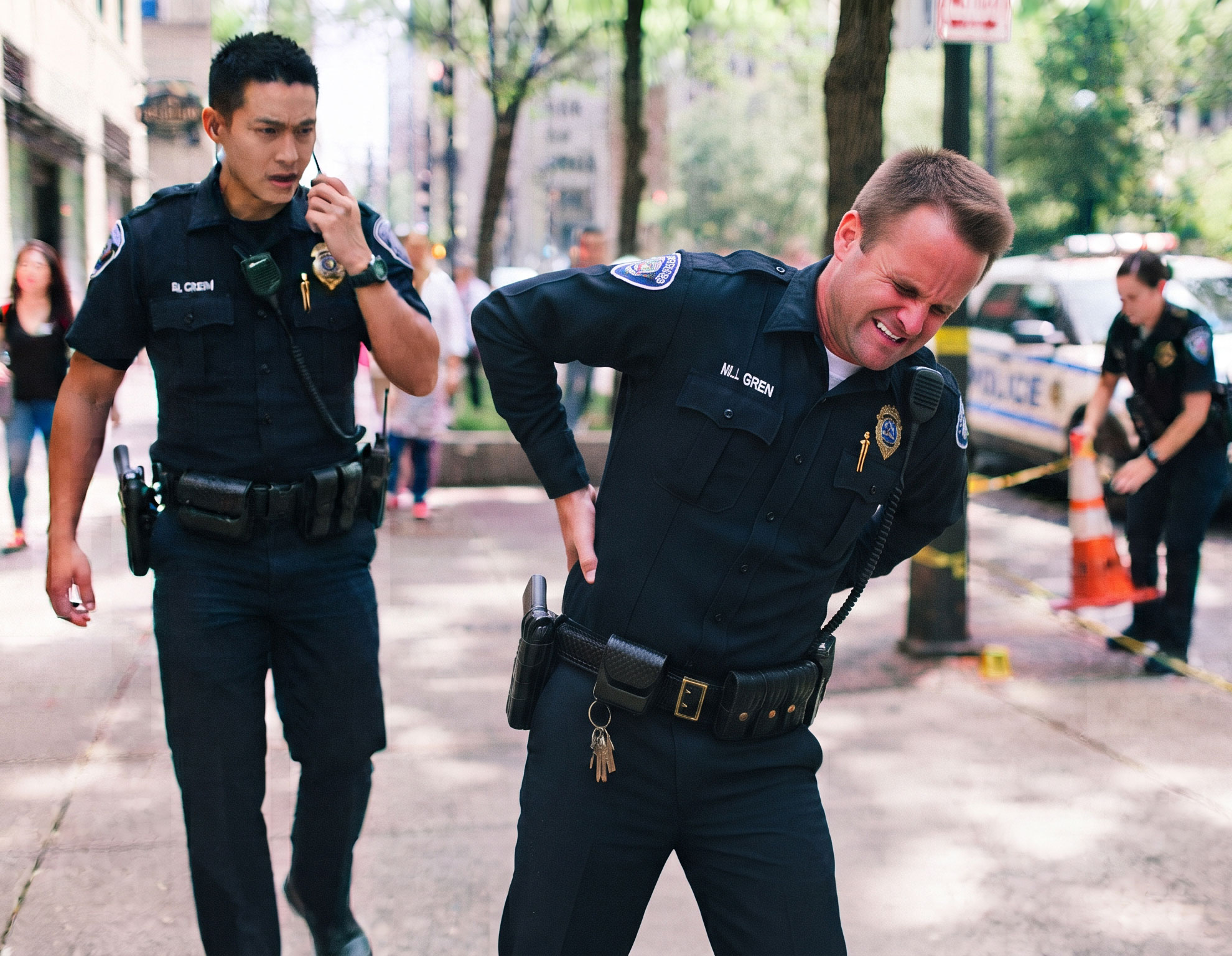
From Sitting to Full Speed
One of the most unique physical demands of law enforcement is how quickly the job can change.
An officer may spend a significant amount of time sitting in a vehicle and then suddenly need to get out and move at full speed.
There may be no warm-up, stretching, or gradual increase in activity.
The body simply needs to be ready.
For someone returning from a knee, hip, back, ankle, or other musculoskeletal injury, being comfortable during everyday activities may not be enough.
The real question is whether that officer can go from relative inactivity to demanding physical activity safely and effectively.
The Job Can Require Almost Anything
Police work is difficult to reproduce with a standard exercise program because the physical demands can vary dramatically from one situation to the next.
An officer may need to:
- Perform CPR
- Run during a pursuit
- Move quickly from a seated position
- Get over a fence or other obstacle
- Control someone who is physically resisting
- Move on or near the ground
- Carry or move substantial weight
- Generate force quickly when needed
That means rehabilitation needs to extend beyond isolated strength exercises.
The officer needs to regain the physical capacity necessary for the unpredictable demands of the job.
Rehabilitation Should Look Like the Job
If an officer may need to get over a fence while wearing additional weight, eventually rehabilitation should address that type of movement.
In the clinic, that could mean progressing to a weighted vest and practicing getting over appropriately sized obstacles.
If the job requires getting to the ground and controlling another person, rehabilitation may need to challenge the officer in lower positions and awkward movement patterns.
If strength under load is important, carrying or moving a heavy sandbag may become part of the progression.
The purpose is not to create difficult exercises just for the sake of making therapy harder. It is to recreate the physical problems the officer may actually have to solve at work.
Fatigue and Awkward Positions Matter
Being able to perform a movement while rested is only part of the picture.
Physical confrontations do not necessarily happen when an officer is fresh.
Neither do pursuits or emergency responses.
An officer may already be tired when they suddenly have to generate force, change direction, get to the ground, stand back up, or control another person's movement.
That is why rehabilitation may need to evaluate performance under fatigue and in positions that are less controlled than a traditional exercise.
A knee that feels strong during a basic exercise needs to remain strong when the officer is tired.
A leg that performs well in a predictable environment needs to be able to generate force in a much less predictable one.
Sometimes the Most Important Exercise Is Very Specific
One officer I worked with described something I had not previously considered in a typical rehabilitation setting: he sometimes needed to kick in a door as part of his job.
That became important to his rehabilitation.
We began by working on the forces involved in that movement using heavy resistance.
Later, during work conditioning, we made the task substantially more demanding.
He kicked a heavy D-ball—a large rubber ball filled with sand—using the leg that had undergone surgery.
We progressed the resistance over time, eventually working up to a 150-pound ball.
The goal was not simply to make his leg stronger. It was to develop the capacity to generate the type of force his actual job could require.
Progressively Building Capacity
Job-specific rehabilitation does not mean immediately asking someone recovering from an injury to perform the hardest possible task.
It means progressing toward that task.
In this officer's case, the kicking exercise progressed from lighter resistance to increasingly heavier loads.
That progressive approach allowed us to build strength, tolerance, and capacity over time.
The same concept can apply to:
- Running
- Obstacle clearance
- Getting on and off the ground
- Carrying weight
- Changing direction
- Generating force quickly
You identify the demand and then progressively build toward it.
Confidence Is Part of Returning to Duty
There is another important benefit to practicing job-specific tasks during rehabilitation: confidence.
An officer returning from surgery should not encounter a physical confrontation and suddenly wonder whether the injured leg is going to hold up.
Ideally, that question has already been tested.
- The officer has already loaded the injured area.
- They have already generated force with it.
- They have already worked while tired.
- They have already progressed through increasingly difficult versions of the task.
In the case of the officer practicing the door-kicking movement, that preparation meant he could return to work knowing he had already challenged his surgical leg under demanding conditions.
That preparation helps remove the self-doubt that can appear when an officer is suddenly faced with a demanding situation in the field.
Standard Rehabilitation May Not Be Enough
Traditional physical therapy is very good at restoring things such as strength, mobility, balance, and basic movement.
But law enforcement may require another level of preparation.
The equipment, space, and time necessary to practice job-specific tasks are not available in every rehabilitation setting.
That matters.
An officer does not just need to demonstrate that a knee bends properly or that a leg is stronger.
They may need to demonstrate that they can run, get over an obstacle, move weight, work from the ground, generate force, and continue performing when tired.
The Goal Is Returning Ready
For law enforcement officers, returning to work means returning to a profession where the next physical demand may arrive with almost no warning.
An officer could be sitting in a cruiser one moment and responding to an emergency the next.
That is why rehabilitation should not end simply because pain has decreased or basic strength has returned.
The goal is to progressively rebuild the officer's ability to perform the movements their job actually requires.
When an officer returns to duty, they should not be wondering whether their body can handle the situation in front of them. They should have already put it to the test.